
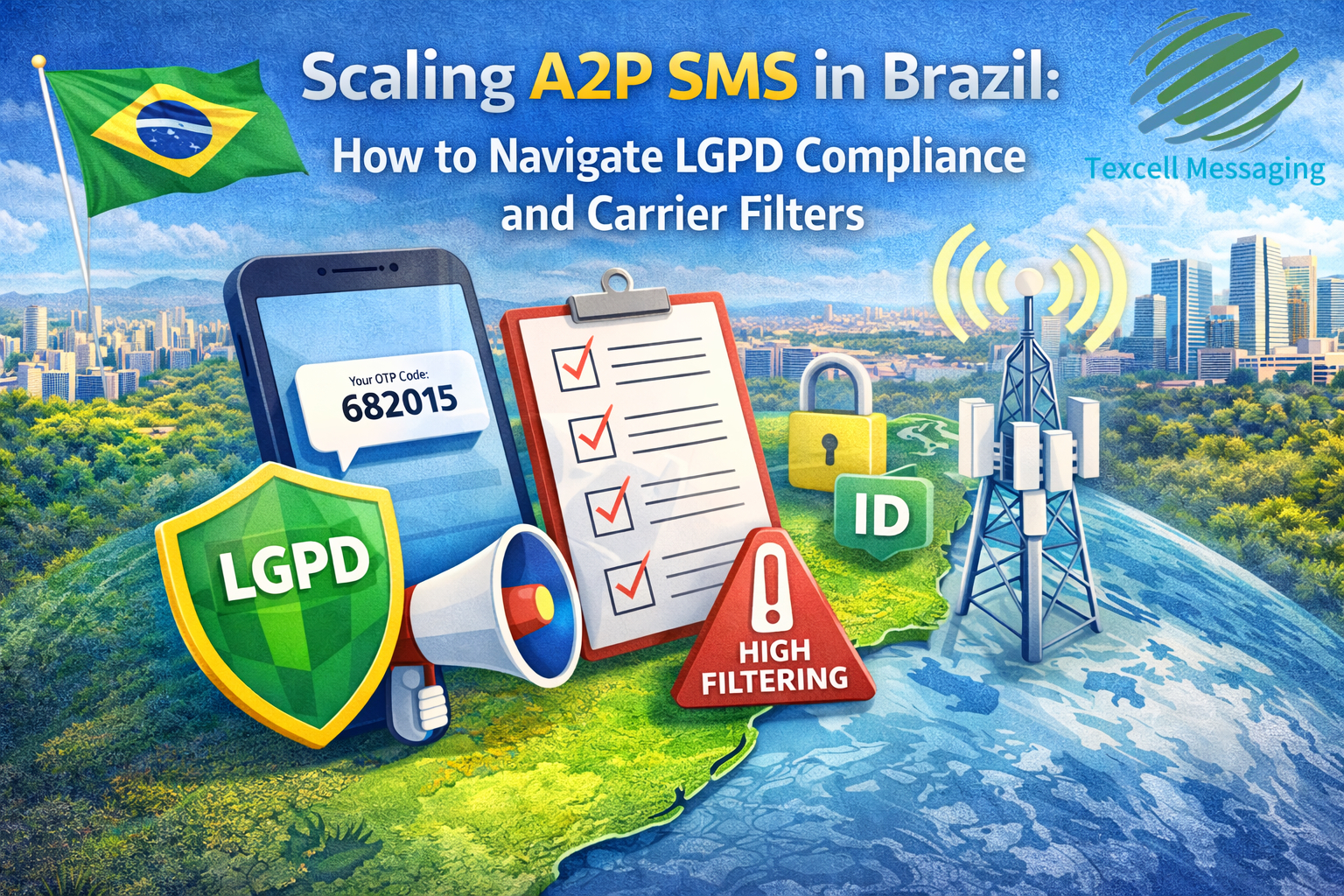
Brazil has emerged as a strategic market for A2P SMS, with enterprises increasingly relying on text messaging for customer authentication, service updates, and time-sensitive marketing communication. As mobile usage continues to expand across industries such as fintech, e-commerce, digital services, and online platforms, A2P SMS in Brazil remains a critical communication channel.
At the same time, Brazil’s regulatory environment and carrier policies have become more structured. The introduction of LGPD has reshaped how businesses approach user data, consent management, and message transparency. For companies scaling A2P SMS in Brazil, understanding how LGPD principles intersect with carrier filtering rules is essential for maintaining stable delivery rates.
In practice, LGPD does not prevent businesses from sending A2P SMS. Instead, it emphasizes responsible data handling, lawful purpose, and clear user consent. Businesses sending OTP verification messages, account alerts, or service notifications often fall within legitimate communication use cases when proper consent is obtained. Promotional messaging can also operate within LGPD-aligned practices when opt-in mechanisms and clear sender identification are applied.
Carrier filtering in Brazil operates at multiple levels. Operators evaluate sender reputation, traffic consistency, content signals, and historical complaint patterns. Sudden traffic spikes, unclear sender identification, or repetitive promotional phrasing may trigger filtering regardless of message intent. This is why scaling A2P SMS in Brazil requires not only compliance awareness, but also stable routing and traffic planning.
Texcell Messaging supports businesses looking to scale A2P SMS in Brazil by providing direct and optimized routes designed to support consistent sender reputation and traffic transparency. Our infrastructure helps enterprises deliver OTP messages, transactional alerts, and promotional campaigns while aligning with local operator expectations. Businesses exploring Brazil A2P SMS can register directly through our platform to evaluate routing performance and delivery behavior at scale:
https://www.texcellsms.com/user/register
Another critical factor when expanding A2P SMS in Brazil is sender identity management. Using appropriate Sender IDs, maintaining traffic consistency, and aligning message templates with local communication norms significantly reduces filtering risk. In many cases, delivery challenges are not caused by pricing or volume, but by sender reputation and message structure over time.
As Brazil’s digital economy continues to mature, A2P SMS will remain a foundational communication tool. Businesses that invest in compliant traffic strategies, stable routing, and local carrier alignment will be better positioned to scale messaging operations without disruption. For companies seeking long-term success in A2P SMS in Brazil, choosing an experienced global messaging provider is a critical first step.
Learn more about Texcell Messaging and our global A2P SMS solutions at
https://www.texcellsms.com