
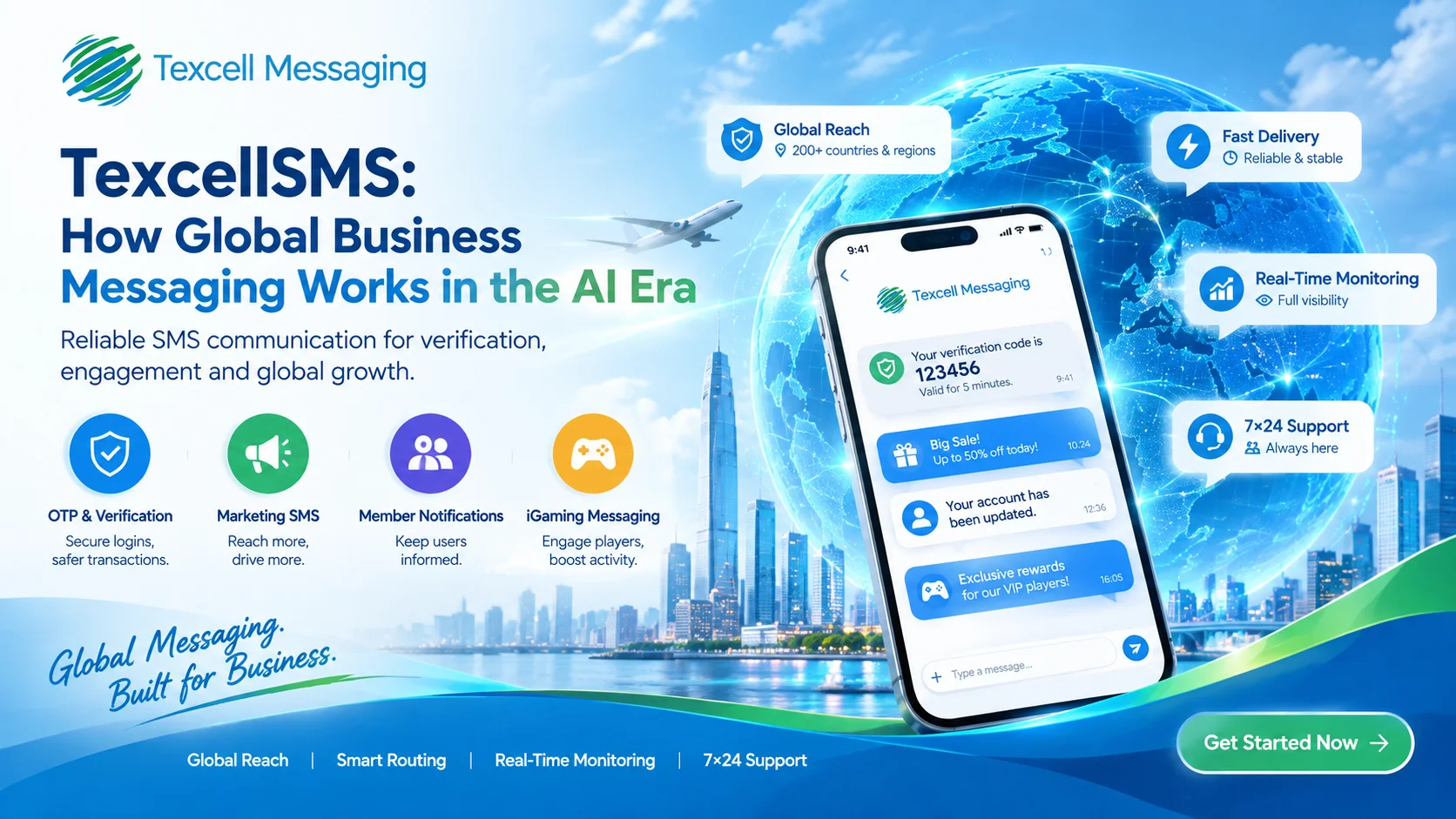
TexcellSMS: How Global Business Messaging Works in the AI Era
The way businesses communicate with customers is changing rapidly. Artificial intelligence is transforming customer service, marketing, fraud detection and digital operations, while businesses are expanding across more markets than ever before.
But one thing has not changed: customers still need to receive important information quickly, clearly and reliably.
This is where international SMS continues to play an important role. Rather than competing with every new communication technology, SMS has become a practical communication layer connecting digital services with real users across different countries, devices and networks.
Why Messaging Reliability Matters More in the AI Era
AI can generate content, automate conversations and help businesses make decisions at unprecedented speed. At the same time, the growth of AI-generated scams, impersonation and automated cyber activity is increasing the importance of customer trust and identity verification. Recent industry discussions have highlighted how AI is being used to make fraud more sophisticated and scalable. :contentReference[oaicite:1]{index=1}
For businesses, this creates an interesting paradox. Communication is becoming faster, but reliable communication is becoming more valuable.
A customer may interact with an AI assistant, receive an email, use a mobile application and complete a payment within seconds. However, when the business needs to confirm an identity, notify a customer about an important event or deliver a time-sensitive message, a dependable mobile messaging channel remains highly practical.
This is one reason why a professional global SMS gateway should not simply be evaluated by price. Delivery performance, routing quality, monitoring capabilities, local market requirements and operational support all influence the actual value of the messaging infrastructure.
SMS Is Becoming Part of the Customer Journey
Modern SMS communication is no longer limited to sending a verification code. A well-designed messaging strategy can support several stages of the customer journey.
1. OTP and Identity Verification
OTP SMS remains one of the most common use cases for digital businesses. It can support registration, login confirmation, account recovery, transaction verification and other identity-related processes.
However, businesses should not treat OTP SMS as a complete security solution. SMS is one layer within a broader authentication and fraud-prevention strategy. The real objective is to deliver the right verification message at the right moment while maintaining a smooth customer experience.
2. Marketing and Customer Engagement
SMS marketing can help brands communicate time-sensitive offers, product launches, seasonal campaigns and customer updates directly to mobile users.
The most effective campaigns are not necessarily the ones that send the highest number of messages. They are the ones that understand timing, audience segmentation, local regulations and message relevance.
For businesses operating internationally, this becomes more complex because customer expectations and communication requirements vary from market to market.
3. Member and Service Notifications
Customers often need immediate information about account activity, orders, delivery progress, appointments, subscriptions or service changes.
In these situations, the purpose of SMS is not aggressive promotion. It is information delivery.
A reliable international SMS infrastructure can help businesses build a consistent communication layer across different markets while reducing the complexity of managing multiple local messaging resources.
4. iGaming and Real-Time Customer Communication
For iGaming businesses, timing can have a direct impact on user engagement. Registration verification, account notifications, promotional campaigns, event reminders and player reactivation all require communication that reaches users quickly.
At the same time, businesses operating in regulated markets need to consider local messaging requirements, customer consent and responsible communication practices.
What Should Businesses Evaluate When Choosing an SMS Provider?
Choosing an international SMS provider should be approached as an infrastructure decision rather than simply a price comparison.
First, consider delivery consistency. A low-cost route that frequently experiences delays or failed delivery may create additional costs through repeated attempts, customer complaints and lost conversions.
Second, evaluate routing quality. Different countries have different carrier structures, regulations and traffic characteristics. A provider with strong international routing resources can respond more effectively to these differences.
Third, monitoring matters. Businesses should be able to understand traffic performance, delivery results and potential route issues instead of operating without visibility.
Fourth, scalability is important. A solution that works for a small testing volume should also be capable of supporting higher traffic during product launches, major promotions or seasonal campaigns.
Finally, technical and operational support should not be overlooked. When messaging becomes part of a customer's login, payment or purchasing journey, communication infrastructure needs professional support.
From Global Reach to Local Relevance
Global communication does not mean using exactly the same strategy everywhere.
A successful global SMS gateway should provide international connectivity while allowing businesses to adapt their messaging strategy to individual markets.
This includes sender configuration, routing selection, local compliance considerations, message templates, traffic monitoring and campaign optimization.
The goal is simple: create a communication infrastructure that is global in scale but local in execution.
How TexcellSMS Supports Global Business Messaging
TexcellSMS provides global bulk SMS connectivity for businesses that need reliable communication across international markets.
Its solutions are designed around key business scenarios including OTP verification, promotional SMS, member notifications and iGaming marketing.
Instead of focusing only on message volume or headline pricing, TexcellSMS emphasizes delivery stability, routing performance, real-time monitoring and scalable infrastructure.
Businesses can use the global SMS gateway to build a more consistent messaging layer for international operations.
For companies testing new markets, launching new services or expanding existing communication traffic, a stable messaging infrastructure can make international expansion easier to manage.
The Future of Business Messaging Is About Trust
AI will continue to change how businesses communicate. Automated assistants will become more capable, customer interactions will become more personalized, and digital services will become increasingly intelligent.
But technology does not remove the need for trust.
When a customer needs to verify an account, receive an important notification or respond to a time-sensitive offer, the message still needs to reach the right person at the right time.
That is why business messaging should be viewed as part of the customer experience rather than simply another communication channel.
The companies that succeed in global markets will not necessarily be those that send the most messages. They will be the ones that build reliable, relevant and responsible communication journeys.
AI may change how businesses communicate. Reliable messaging determines whether customers actually receive it.
Ready to build a more reliable international messaging strategy? Get started now.