
Texcellsms: How Global Business Messaging Works in Brazil, Australia, & SEA
In today's interconnected global market, reaching cross-border customers quickly, securely, and in compliance with regional regulations is critical for business expansion. While instant messaging apps continue to gain popularity, Application-to-Person (A2P) Short Message Service (SMS) remains the foundational channel for enterprise communication. Text messaging delivers immediate visibility for time-sensitive passcodes, transaction updates, and targeted promotions. Operating as an enterprise-grade global SMS gateway, Texcellsms connects global brands with regional telecommunication networks, delivering reliable solutions for OTP verification SMS, mega promotional campaigns, account alerts, and regulated industry workflows across key growth markets.
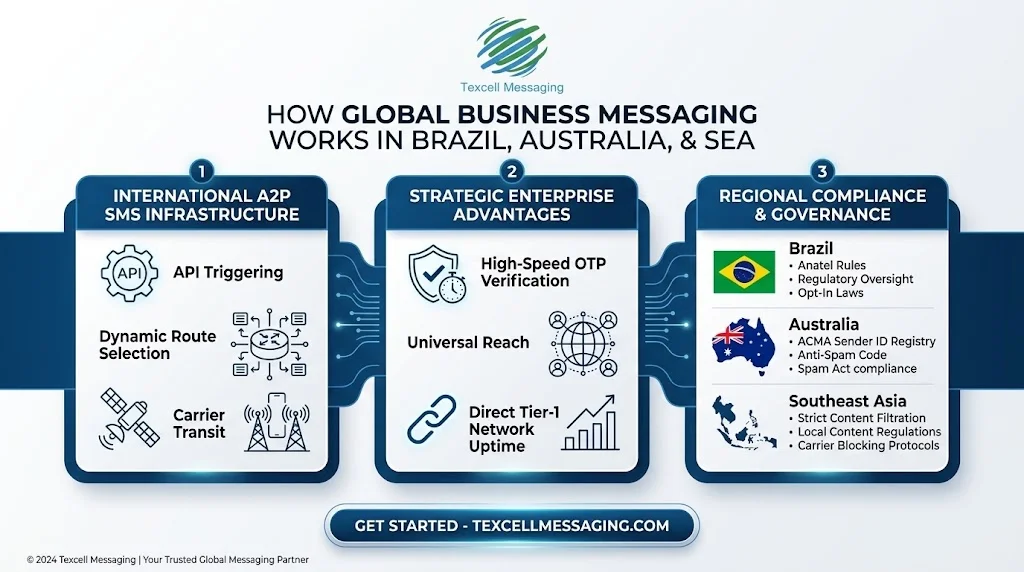
How International A2P SMS Delivery Works
Delivering a business SMS across international borders requires a sophisticated routing infrastructure to navigate carrier networks and regulatory checkpoints:
- API Triggering: An enterprise application generates a message payload (e.g., an OTP code or transactional notice) and sends it to the platform via REST API or SMPP protocol.
- Intelligent Route Selection: The Texcellsms routing engine evaluates the destination MCC/MNC (Mobile Country Code/Mobile Network Code), route health, latency, and carrier restrictions to select an optimal Tier-1 path.
- Carrier Network Transit: The message traverses international signaling networks (SS7/Sigtran) to reach the recipient's home network Mobile Switching Center (MSC).
- Delivery Status Tracking: The destination operator returns a real-time Delivery Receipt (DLR), enabling continuous monitoring of deliverability and route stability.
The Strategic Role of SMS in Global Business Operations
Enterprises rely on A2P SMS because of its universal device compatibility, zero app download requirement, and reliable security performance. Unlike push notifications that depend on active internet access and specific mobile apps, SMS works natively on every mobile phone globally. For critical functions like dispatching an OTP verification SMS during user onboarding or payment authorization, sub-second delivery is essential to minimize user drop-off. Texcellsms utilizes direct Tier-1 carrier connections where available to bypass unstable grey routes, providing reliable throughput and system observability that protect user conversion funnels.
Navigating Compliance in Brazil, Australia, Indonesia, and the Philippines
Expanding into high-growth regions requires a clear understanding of local telecom regulations and operator filtering rules, particularly for high-traffic sectors like e-commerce, fintech, and iGaming:
- Brazil: Governed by Anatel guidelines, messaging in Brazil requires strict Sender ID handling, clear opt-out management for promotional broadcasts, and compliant routes to handle high-volume user acquisition campaigns.
- Australia: The Australian Communications and Media Authority (ACMA) enforces strict anti-spam rules. With the implementation of the ACMA SMS Sender ID Register, unregistered branded Sender IDs face blocking or filtering, making verified registration essential for brand delivery.
- Indonesia: Mobile operators enforce rigorous content filtration against unverified promotional messages. Delivering iGaming or promotional traffic requires adaptive content formatting and compliant route management to avoid carrier blocks.
- The Philippines: Under PAGCOR frameworks and the SIM Registration Act, delivery during peak sports and promotional events requires pre-registered Sender IDs and high-capacity transactional routes to maintain inbox placement.
Texcellsms assists enterprises by aligning technical messaging strategies with local market policies, providing real-time number lookup (HLR), and offering adaptive routing to maintain high inbox delivery rates.
Key Criteria for Evaluating an International SMS Provider
When selecting a global messaging partner, technical decision-makers should consider the following criteria:
- Network Coverage & Route Stability: Direct Tier-1 connections and intelligent failover routes to ensure low latency during traffic spikes.
- Regulatory & Compliance Support: Guidance on local Sender ID registration requirements, such as Australia's ACMA register and regional anti-spam guidelines.
- API Integration & Monitoring: Flexible REST API and SMPP 3.4 support with real-time DLR analytics and 7x24 operational support.
- Cost & Performance Balance: Transparent destination-based pricing with intelligent retry logic to optimize overall campaign ROI.
Frequently Asked Questions
What is the difference between direct Tier-1 routes and grey routes?
Direct Tier-1 routes connect straight to mobile network operators, ensuring high deliverability, low latency, and full DLR accuracy. Grey routes exploit unapproved transit paths, leading to delayed messages, missing OTPs, and sudden route blocks.
How can enterprises prevent OTP delivery delays during high-traffic events?
Enterprises should implement adaptive retry strategies, set reasonable OTP expiration windows (e.g., 3 to 5 minutes), and partner with a provider that offers dynamic failover routing.
Scale Your Global Communications with Texcellsms
Do not let route degradation or compliance roadblocks limit your international expansion. Partner with a messaging service provider that understands cross-border telecom regulations and global routing performance. Get Started today to optimize your messaging conversion rates and scale your global footprint with Texcellsms.