
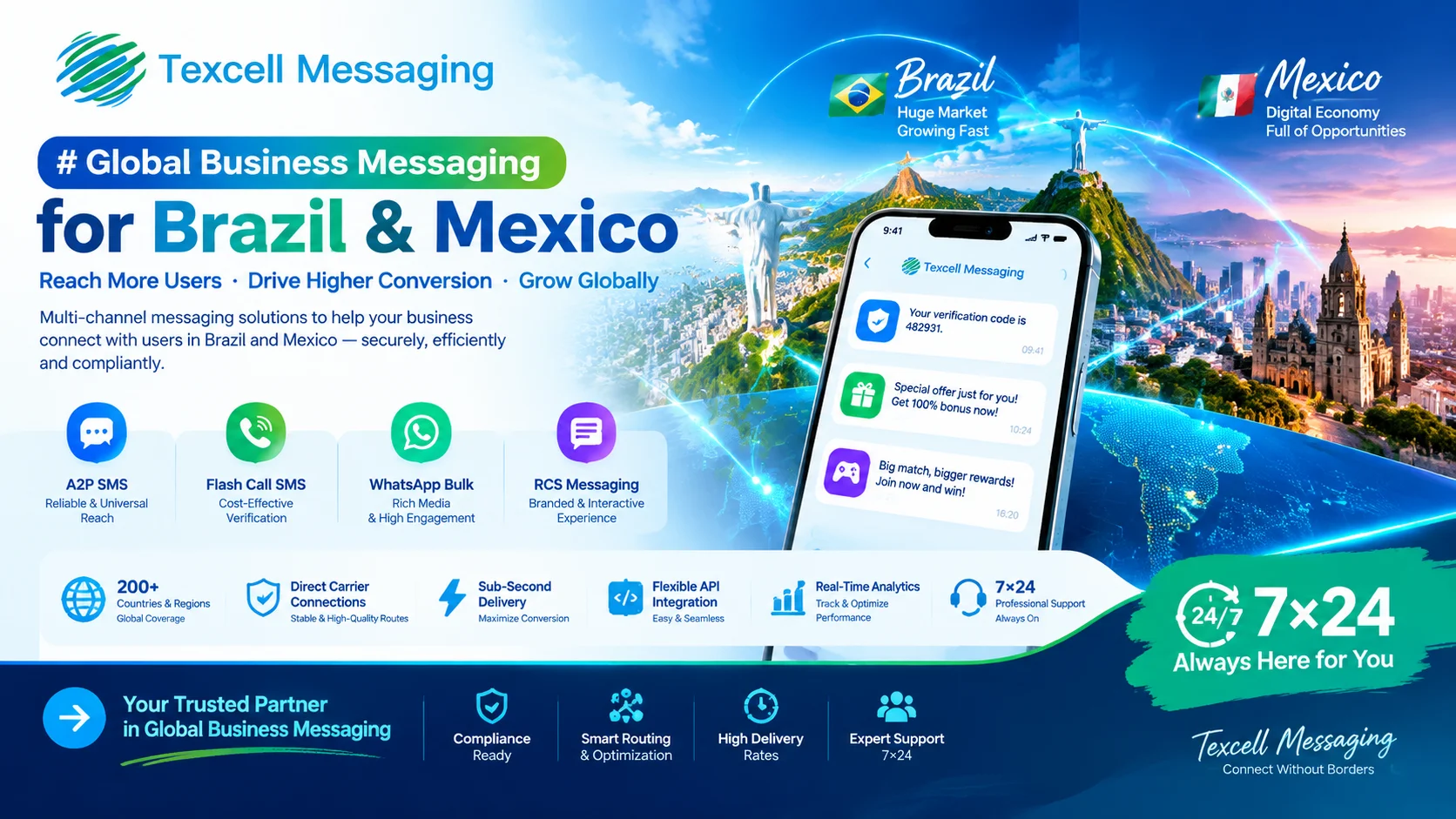
 Texcellsms: Global Business Messaging for Brazil & Mexico
In today's highly dynamic global market, expanding into fast-growing digital economies like Brazil and Mexico presents both massive opportunities and complex communication challenges. As enterprises compete for cross-border user acquisition, relying on a single communication channel is no longer sufficient. High delivery latency, local carrier filtration, and rising transit fees often lead to user drop-offs during onboarding and payment workflows. To solve these friction points, modern enterprises adopt a multi-channel messaging stack combining Application-to-Person (A2P) Short Message Service (SMS), Flash Call (Voice Drop) SMS, WhatsApp bulk messaging, and Rich Communication Services (RCS). As an enterprise-grade global SMS gateway and omnichannel communication platform, Texcellsms enables brands to deliver compliant OTP passcodes, transactional alerts, and high-converting marketing campaigns across more than 200 countries and regions.
How Global Enterprise Messaging Works Behind the Scenes
Delivering time-sensitive messages across international borders requires robust API integration and intelligent routing infrastructure to navigate carrier networks and regulatory checkpoints:
- Application Layer Trigger: The enterprise system generates a payload (such as an OTP verification code, order update, or promotional message) and sends it to the messaging platform via REST API or SMPP protocol.
- Smart Channel & Route Matching: The Texcellsms engine analyzes the destination MCC/MNC (Mobile Country Code/Mobile Network Code), message type, latency requirements, and cost profiles to assign the optimal delivery channel (SMS, Flash Call, WhatsApp, or RCS).
- Telecom & Data Network Transit: The message traverses Tier-1 signaling transit networks (SS7/Sigtran) or direct OTT API gateways to reach local mobile operators or data servers.
- Real-time Delivery Observability: The destination operator or network returns a Delivery Receipt (DLR), allowing business operators to track delivery metrics, latency performance, and conversion analytics.
Unlocking Multi-Channel Value: SMS, Flash Call, WhatsApp, and RCS
Modern businesses must balance delivery speed, cost optimization, and user engagement by deploying an integrated messaging strategy:
| Messaging Channel | Core Characteristics | Ideal Business Use Cases |
|---|---|---|
| A2P SMS | Universal mobile reach, zero app dependency, instant delivery. | OTP passcodes, critical security alerts, order confirmations. |
| Flash Call SMS | Voice call drop where the last digits form the verification code; ultra-cost-effective. | Secondary OTP fallback, registration verification, user login. |
| WhatsApp Bulk | Rich media support, interactive buttons, high user engagement in LATAM. | Promotional broadcasts, VIP re-engagement, customer support. |
| RCS Messaging | Branded sender profile, verified badges, rich carousels on native Android messaging. | Interactive product catalogs, high-value promotional campaigns, iGaming offers. |
Navigating Telecom Compliance in Brazil and Mexico
Latin America’s largest markets require deep localized knowledge of carrier regulations and anti-spam laws:
- Brazil: Governed by Anatel regulations, enterprise messaging requires verified Sender ID management, strict opt-out compliance for promotional broadcasts, and compliant routes to handle peak sales periods like Black Friday. WhatsApp and RCS are dominating consumer engagement, making verified branded profiles essential for high conversion.
- Mexico: Overseen by the Federal Telecommunications Institute (IFT), local operators enforce aggressive filtration on unverified marketing SMS. Implementing a failover sequence—such as attempting RCS or WhatsApp first, followed by A2P SMS or Flash Call—ensures high deliverability while keeping acquisition costs under control.
Texcellsms assists cross-border businesses in SaaS, e-commerce, fintech, and iGaming by structuring adaptive routing algorithms, real-time number lookup (HLR), and localized compliance templates to maximize inbox delivery.
Evaluating Your Global Messaging Partner
When selecting a global messaging provider, enterprise buyers should focus on key technical and operational standards:
- Route Quality & Latency: Direct Tier-1 connections that ensure sub-second OTP delivery during traffic spikes.
- Channel Diversity: Ability to seamlessly switch between SMS, Flash Call, WhatsApp, and RCS to balance costs and deliverability.
- API Observability: Comprehensive REST/SMPP API documentation, granular DLR reporting, and 7x24 technical monitoring.
- Regulatory Expertise: In-depth understanding of local Sender ID registration, anti-spam rules, and opt-out requirements.
Frequently Asked Questions
What is Flash Call SMS and how does it save costs?
Flash Call generates an automated missed call to the user's mobile device, where the last digits of the calling number serve as the verification code. It significantly reduces verification costs compared to traditional SMS while maintaining high security.
How do WhatsApp bulk messaging and RCS improve conversion rates?
Both WhatsApp and RCS allow brands to display verified business profiles, images, action buttons, and interactive carousels, dramatically increasing click-through rates (CTR) compared to plain text messages.
Scale Your Business in Brazil and Mexico with Texcellsms
Do not let route instability, rising transit costs, or regulatory roadblocks hinder your international expansion. Partner with an omnichannel messaging provider that understands cross-border telecom regulations and multi-channel delivery strategies. Get Started today to optimize your conversion rates and scale your global footprint with Texcellsms.